
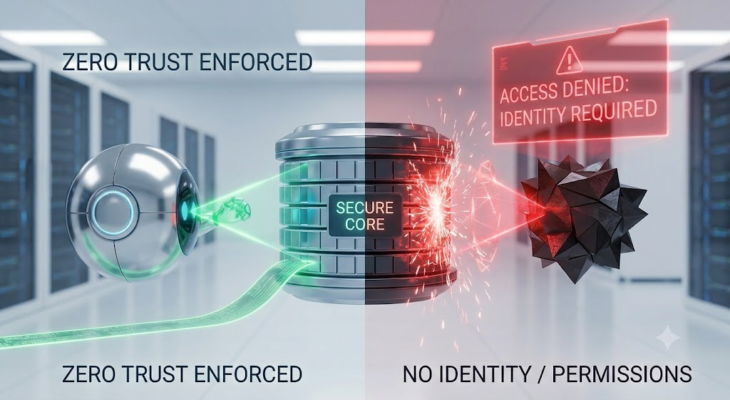

Zero Trust for AI Agents: Identity, Access & Accountability
AI agents are moving beyond answering questions. They can access databases, call APIs, modify files, send messages and initiate business processes.
That ability creates value, but it also creates risk. An agent using a shared administrator account may have far more access than it needs. If it makes a mistake, follows a malicious instruction or uses a compromised tool, the organization may struggle to determine what happened.
A Zero Trust approach helps control this risk. Every AI agent should have a verifiable identity, narrowly defined permissions and a complete audit trail.
What Does Zero Trust Mean for AI Agents?
Zero Trust is based on a simple principle: never grant trust automatically. Verify every request and provide only the access required for the task.
NIST’s Zero Trust guidance applies this approach to users as well as non-person entities, applications and services. An AI agent should therefore be treated as a separate digital identity—not as an invisible extension of a user or shared system account.
For every sensitive action, the system should evaluate:
- Which agent is making the request?
- Who or what authorized it?
- What task is it performing?
- Which resource is it trying to access?
- Does it need read, write, execute or delete permission?
- Is the request consistent with policy and expected behavior?
1. Give Every AI Agent a Unique Identity
A unique identity makes the agent individually authenticatable, manageable and traceable.
When several agents share credentials, security teams cannot reliably attribute an action to a particular workload. Shared credentials also increase the impact of a leak because one exposed secret may unlock multiple systems.
Each agent should instead receive its own workload or service identity. Credentials should be short-lived where possible, stored securely and rotated automatically. Access should also be revoked as soon as the agent is disabled or its task ends.
This identity should remain connected to the human user, application or workflow that delegated the task. That creates a clear chain of responsibility.
2. Enforce Least-Privilege Permissions
An agent that only reads support tickets does not need permission to delete them. A reporting agent should not automatically receive access to payroll data or production infrastructure.
Permissions should be limited by:
- Resource, such as a specific database or folder
- Action, such as read instead of edit or delete
- Time, including temporary access for one task
- Context, such as the requesting user and data sensitivity
- Risk, with approval required for high-impact actions
This matters because OWASP identifies excessive functionality, permissions and autonomy as major sources of risk in AI-enabled applications. Its guidance recommends narrowly scoped tool permissions and monitoring agent activity. See the OWASP guidance on excessive agency.
Human approval should remain mandatory for actions such as transferring money, deleting records, changing security policies or publishing sensitive information.
3. Maintain a Complete AI Audit Trail
Authentication tells you which agent connected. An audit trail explains what it did.
Agent logs should capture:
- Agent and delegated-user identity
- Requested tool or resource
- Authorization decision
- Action performed
- Timestamp and session identifier
- Result or system change
- Human approval, when required
- Policy violations and unusual behavior
Logs should be tamper-resistant, searchable and connected to the organization’s security monitoring platform. Sensitive prompts, personal data and credentials should be redacted rather than stored in plain text.
The OWASP AI Agent Security Cheat Sheet specifically recommends scoped tool permissions and audit trails for compliance and forensic investigations.
A Practical Zero Trust Checklist
Before deploying an AI agent, confirm that:
- The agent has a unique identity.
- It does not use shared administrator credentials.
- Its tools and permissions match its exact purpose.
- Credentials are short-lived and securely managed.
- High-risk actions require human approval.
- Every action produces a traceable security event.
- Permissions are reviewed and removed when no longer needed.
- Unusual behavior can trigger alerts or automatically suspend access.
How Hexatic Tech Can Help
Hexatic Tech helps organizations apply cybersecurity controls to AI agents before excessive access becomes a business risk.
Our Zero Trust approach can help your organization:
- Discover AI agents and map their access
- Design unique identities for agent workloads
- Apply role-based and least-privilege permissions
- Protect API keys, tokens and machine credentials
- Introduce approval gates for sensitive actions
- Centralize agent logs for monitoring and investigation
- Review AI workflows for security and compliance gaps
AI agents should be useful without becoming unmonitored privileged users. Hexatic Tech can help you build an identity-first security model that keeps every agent visible, controlled and accountable.
Ready to secure your AI-agent ecosystem? Contact Hexatic Tech for an AI security and access assessment.