

Weight-Space Programming: Can AI Improve Another AI Without Retraining?
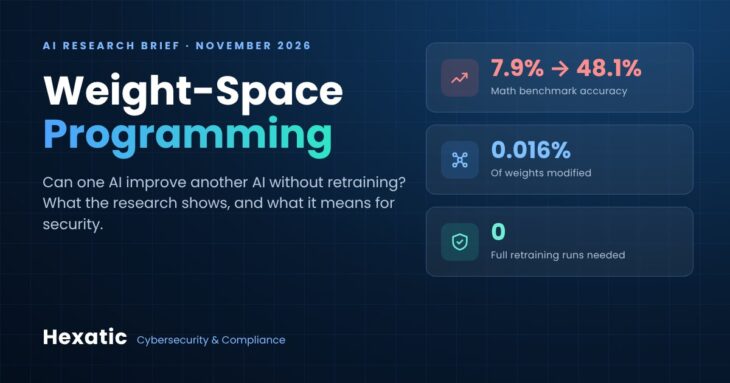
TL;DR: A November 2, 2026 research study, “Sparks of Weight-Space Programming,” reports that an advanced AI (GPT-6 Astra) modified just 0.016% of the weights of a small model, Qwen3.5-0.8B, lifting its math benchmark accuracy from 7.9% to 48.1% without traditional retraining. The gain mostly came from fixing repetitive reasoning, not from new knowledge. The approach is experimental, but it raises real questions about AI security, transparency, accountability, compliance, and reliability when one AI modifies another.
What if artificial intelligence could identify problems inside another AI model and fix them without retraining the entire system?
A new research study, “Sparks of Weight-Space Programming: LLMs Can Natively Read & Write Neural Network Weights,” published on November 2, 2026, explores exactly this possibility.
The research introduces Weight-Space Programming, an emerging approach that allows advanced AI models to examine, understand, and directly modify the internal parameters of neural networks.
This development could open new possibilities for AI optimization, enterprise automation, cybersecurity, and responsible AI development.
What Is Weight-Space Programming?
To understand this technology, imagine an AI model as a machine containing millions of tiny settings. These settings, called neural network weights, determine how the AI processes information and generates responses.
Traditionally, improving an AI model involves training or fine-tuning it using additional data and computational resources. Weight-Space Programming explores a different approach: instead of retraining the entire model, another AI examines its internal weights and makes targeted modifications.
Think of it like fixing a software problem by changing a few specific lines of code rather than rebuilding the entire application. The difference is that AI weights are numerical values, not ordinary programming instructions. The research suggests that advanced language models can sometimes reason about these values and modify them effectively.
The Research Breakthrough: Improving AI by Changing Just 0.016% of Its Weights
One of the study’s most interesting experiments involved OpenAI’s GPT-6 Astra and a smaller language model, Qwen3.5-0.8B. The smaller model struggled with mathematical reasoning, frequently producing repetitive responses instead of completing answers. Researchers used Astra to investigate and modify the model’s weights.
The reported results were remarkable:
- Before modification: 7.9% mathematical benchmark accuracy.
- After modification: 48.1% mathematical benchmark accuracy.
- Weights modified: Just 0.016%.
- Traditional retraining: Not required for the reported modification.
The improvement was approximately sixfold. Importantly, the experiment largely addressed repetitive reasoning behavior. It does not establish that the smaller model acquired entirely new mathematical knowledge. Nevertheless, the findings demonstrate the potential of targeted AI model modifications.
Why Does Weight-Space Programming Matter for the Future of AI?
Weight-Space Programming introduces possibilities beyond conventional model development.
1. More Efficient AI Optimization
Instead of repeatedly retraining models, developers may eventually be able to identify and modify specific parameters to improve performance.
2. Better Understanding of AI Behavior
Researchers demonstrated that an advanced AI could examine neural network weights and identify tasks that other models had learned. This could contribute to AI interpretability and explainability research.
3. Smarter Enterprise AI Systems
Businesses increasingly depend on AI for customer support, automation, analytics, and decision-making. Future weight-space techniques could help organizations investigate model failures and improve specialized AI applications.
4. New Opportunities for AI Security
Understanding model weights could eventually support new approaches to detecting unexpected model behavior, investigating vulnerabilities, and validating AI systems. However, these applications remain potential future developments rather than proven enterprise capabilities.
Can AI Safely Modify Another AI?
As AI systems become more capable, an important question emerges: who controls the changes when AI starts modifying other AI models?
A small modification might improve one capability while unintentionally affecting another. For businesses, this introduces important considerations involving:
- AI security: Preventing unauthorized model modifications.
- Transparency: Understanding what changed and why.
- Accountability: Establishing responsibility for AI-generated changes.
- Compliance: Maintaining appropriate governance and audit records.
- Reliability: Testing modifications before production deployment.
For organizations adopting AI, innovation must be supported by security, responsible governance, and human oversight.
Is This the Beginning of Self-Improving AI?
Weight-Space Programming represents an interesting step toward AI-assisted model improvement. However, it does not mean AI can independently redesign and improve itself without limitations. The research demonstrates promising capabilities under controlled experimental conditions.
Further studies are needed to determine whether these techniques work reliably across larger models, different architectures, and real-world enterprise applications. The future may involve AI systems that help developers identify problems, propose modifications, and optimize other AI models more efficiently, but human validation and responsible implementation will remain essential.
Conclusion: The Future of AI May Be About Improving What We Already Have
Weight-Space Programming highlights an important shift in artificial intelligence research. The next breakthrough in AI may not come only from building larger models, but also from understanding and improving existing ones.
While the technology remains experimental, its potential implications for AI development, optimization, security, and enterprise innovation deserve attention.
At Hexatic Tech Pvt. Ltd., we recognize the importance of staying informed about emerging AI technologies while prioritizing cybersecurity, responsible innovation, and secure digital transformation. As AI continues to evolve, organizations must balance technological advancement with transparency, security, and accountability.
The future of AI isn’t just about making machines more intelligent. It’s also about making them more reliable, understandable, and secure.
Frequently Asked Questions
What is Weight-Space Programming?
Weight-Space Programming is an emerging approach in which an advanced AI model reads, understands, and directly modifies the internal weights of another neural network, instead of retraining that network.
Can AI improve another AI without retraining?
In one controlled experiment, yes. GPT-6 Astra modified 0.016% of the weights of Qwen3.5-0.8B and raised its math benchmark accuracy from 7.9% to 48.1% without traditional retraining. The result is experimental and may not generalize.
Does this mean AI can improve itself?
No. The study shows promising results under controlled conditions. It does not show that AI can independently redesign itself, and the gain mainly reduced repetitive reasoning rather than adding new knowledge.
What are the risks of AI modifying another AI?
Risks include unauthorized model changes, unintended side effects on other capabilities, limited transparency about what changed, unclear accountability, and weak audit records. Modifications should be tested and approved by humans before production use.
Research Reference
Research paper: Sparks of Weight-Space Programming: LLMs Can Natively Read & Write Neural Network Weights
Published: November 2, 2026
Read the research: alphaxiv.org
Experimental logs: github.com/RikiyaT/lm_understand-logs