
- October 28 2026
-
 Amar Khadake
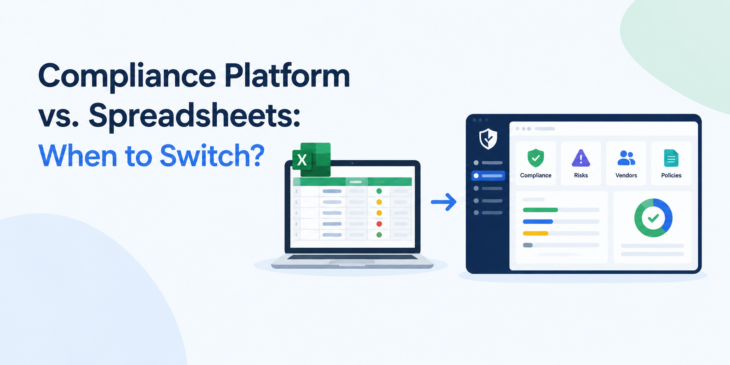
Compliance Platform vs. Spreadsheets: When to Switch?
Introduction
Compliance management is no longer just about maintaining documents, updating spreadsheets, and preparing evidence before an audit, it has become a daily operational discipline. Organizations must continuously manage risks, monitor controls, review policies, assess vendors, and demonstrate that their compliance activities are operating effectively.
For many businesses, spreadsheets are the natural starting point. They are familiar, affordable, flexible, and easy to set up. A simple spreadsheet can help a small team track compliance requirements, assign responsibilities, record due dates, and monitor progress.
However, as an organization grows and adopts additional compliance frameworks such as ISO 27001, SOC 2, GDPR, or India’s Digital Personal Data Protection (DPDP) framework, managing everything through spreadsheets can become increasingly difficult.
Multiple files, manual reminders, inconsistent evidence, version-control issues, and limited visibility can turn compliance into a time-consuming administrative exercise.
This raises an important question: When should your business move from spreadsheets to a dedicated compliance management platform?
The answer depends on the complexity of your compliance requirements, the size of your team, the number of frameworks you manage, and the level of visibility and accountability your organization needs.
In this blog, we explore the differences between spreadsheets and compliance platforms, the warning signs that indicate it may be time to switch, and how organizations can make the transition effectively.
Understanding Spreadsheet-Based Compliance Management
Spreadsheets are commonly used to organize compliance requirements and track implementation activities. They can contain control lists, risk registers, policy inventories, vendor assessments, evidence references, audit observations, and compliance calendars.
For organizations with limited compliance requirements, a well-designed spreadsheet may provide a practical starting point.
Advantages of using spreadsheets
- Low initial cost: Teams can often begin with tools they already have.
- Familiarity: Most employees understand how to use spreadsheet applications.
- Flexibility: Columns, formulas, filters, and conditional formatting can be customized.
- Quick setup: A basic tracker can be created without a lengthy implementation process.
- Simple reporting: Small datasets can be summarized through charts, pivot tables, and formulas.
Where spreadsheets begin to struggle
The limitations become apparent when multiple teams, frameworks, vendors, and recurring compliance activities need to be managed together.
For example, an organization implementing ISO 27001 may need to track control implementation, policy approvals, risk treatment, employee awareness, vendor assessments, and evidence collection. If these activities are maintained in separate spreadsheets, the compliance team must continuously reconcile information across files.
A missed update in one workbook can create inconsistencies in another. A task owner may not receive a reminder, evidence may become outdated, or management may receive a progress report based on incomplete information.
Spreadsheets can still be useful, but maintaining them as the primary system of record becomes harder as compliance operations grow.
What Is a Compliance Management Platform?
A compliance management platform is a centralized system designed to help organizations plan, implement, monitor, and demonstrate compliance activities.
Instead of maintaining separate trackers for every process, teams can manage compliance requirements, controls, policies, risks, vendors, tasks, and evidence within a connected workspace. Organizations should evaluate the actual capabilities of a solution against their requirements.
The primary difference is that a spreadsheet records information, whereas a well-designed compliance platform can connect that information to workflows, responsibilities, deadlines, and supporting evidence.
Compliance Platform vs. Spreadsheets: Key Differences
The following comparison highlights how the two approaches differ as compliance requirements become more complex.
Compliance Activity | Spreadsheets | Dedicated Compliance Platform |
Compliance tracking | Manual updates across files | Centralized tracking and status visibility |
Deadline management | Calendar entries or manual reminders | Automated reminders and scheduled tasks, where supported |
Evidence collection | Files stored separately with links or references | Evidence organized against relevant requirements and tasks |
Risk management | Manually maintained risk registers | Structured risk records, ownership, treatment, and review tracking |
Policy management | Manual document version tracking | Policy workflows, approvals, and version history. |
Vendor management | Separate vendor trackers and questionnaires | Centralized vendor profiles, assessments, and follow-ups |
Multi-framework compliance | Manual mapping and reconciliation | Reusable control mappings and framework relationships, where supported |
Audit preparation | Manual evidence gathering and reconciliation | Centralized evidence and activity records to support audit preparation |
Reporting | Formulas, filters, and manual consolidation | Dashboards and reports based on recorded compliance activity |
Accountability | Depends on manual follow-up | Assigned ownership and workflow visibility |
Scalability | Increasing maintenance as files and teams grow | Structured workflows that can scale with organizational needs |
Signs That Your Business Has Outgrown Spreadsheets
There is no universal point at which every organization must switch. However, the following warning signs can help determine whether your current approach is becoming inefficient or risky.
1. You are managing multiple compliance frameworks
Modern organisations frequently align with several frameworks at once. ISO 27001 and SOC 2 are common baselines, joined by region-specific regulations, sector rules, customer-mandated controls, and internal governance policies. Each framework brings its own controls, evidence expectations, reporting obligations, review cycles, and stakeholder responsibilities. Managed manually, they overlap awkwardly and pull governance teams in compatible directions.
Without centralized governance infrastructure, the symptoms are predictable: duplicated efforts across frameworks, inconsistent controls, weak traceability, delayed audits, reduced executive visibility, and accumulating risk exposure. The deeper issue is not compliance management itself; it is operational scalability.
2. Evidence collection consumes too much time
Evidence collection is often one of the most demanding parts of compliance management.
Teams may need to request different documentation like access reviews, security policies, training records, backup records, and incident response documentation from different departments.
When requests are tracked through spreadsheets and email, employees may submit duplicate files, provide outdated evidence, or overlook deadlines.
3. Important deadlines and follow-ups are frequently missed
A spreadsheet can contain due dates, but someone must usually monitor those dates and follow up with the relevant owners unless additional automation has been configured.
As the number of compliance tasks grows, manual reminders become difficult to sustain.
4. You struggle to identify the latest version of a document
Consider a situation in which the compliance team maintains a policy tracker, the IT team stores the current policy in a shared folder, and a department manager has an older copy saved locally.
Which version has been approved? When was it last reviewed? Who authorized the change?
When document versions and approval records are managed manually, answering these questions can require unnecessary effort.
5. Management lacks a reliable view of compliance status
A spreadsheet may tell you how many tasks are marked complete, but that number does not necessarily show whether the supporting evidence is sufficient, whether overdue risks remain unresolved, or whether critical controls are operating effectively.
Management needs more than a completion percentage.
6. Compliance depends on one or two key individuals
If only one employee understands the spreadsheet structure, formulas, naming conventions, and update process, compliance management becomes vulnerable to staff turnover or absence.
Important context may be lost, and the organization may struggle to continue routine activities.
7. Your compliance workload is growing faster than your team
A growing organization may need to manage more employees, vendors, policies, systems, risks, audits, and regulatory requirements without proportionally increasing its compliance headcount.
If the team spends more time maintaining trackers than reviewing risks and improving controls, the process may no longer be sustainable.
When Should You Actually Make the Switch?
The decision should be based on operational complexity rather than company size alone.
A small organization managing a single framework with a handful of owners may be able to operate effectively with spreadsheets. A similarly sized company preparing for multiple audits, managing sensitive information, and coordinating numerous vendors may benefit from a dedicated platform much earlier.
Consider switching when one or more of the following conditions apply:
- You manage multiple frameworks or overlapping compliance requirements.
- Evidence collection and audit preparation regularly consume significant staff time.
- Compliance activities are frequently delayed because of manual follow-ups.
- You cannot confidently identify the latest approved policy or supporting evidence.
- Management reporting requires repeated consolidation across files.
- Risk, vendor, policy, and audit activities are maintained in disconnected systems.
- You need consistent ownership, traceability, and review histories.
- Your compliance process is becoming difficult to maintain as the business grows.
A practical approach is to evaluate both the time spent on administration and the operational risks created by your current process.
The Hidden Cost of Spreadsheet-Based Compliance
In most organizations, governance operations are scattered across spreadsheets, shared drives, email threads, ticketing systems, audit repositories, vendor portals, and department-specific tools. Each system holds part of the truth. None holds the whole picture. When this is the prevailing pattern, the work of being compliant quietly displaces the work of being secure and resilient.
The scale of the problem is now well documented. 92% of the organizations rely on three or more tools to gather audit evidence, and only 39% of the evidence collection process is automated on average. Just 29% of the organizations say their compliance programs consistently meet internal and external standards, and 51% have already received compliance warnings or fines, or fear they soon will.
These numbers describe a recognizable rhythm of work: searching for documentation, reconciling inconsistent records, chasing control owners, rebuilding audit trails, validating policy versions, and coordinating through email chains that nobody can later audit. Very little of this activity advances governance maturity. It simply absorbs hours.
Spreadsheets may have a low initial cost, but the total cost of maintaining a spreadsheet-based compliance process can be higher than expected.
What to Look for in a Modern Compliance Management Platform
If your organization is considering a switch, focus on capabilities that make compliance work more consistent and transparent.
Centralized compliance management
Frameworks, controls, evidence, policies, risks, and vendor assessments should be organized in a connected environment, with access permissions appropriate to each user.
Structured evidence management
The platform should make it clear what evidence is required, which task or control it supports, who must provide it, and whether it has been reviewed.
AI-assisted evidence validation can be useful where available, but important decisions should remain subject to appropriate human review.
Risk-based prioritization
Compliance teams need to distinguish routine activities from issues that could materially affect security, privacy, or business continuity.
A useful platform should support risk ownership, treatment plans, review dates, and progress tracking.
Policy lifecycle management
Look for features that support drafting, review, approval, publication, acknowledgment where required, periodic review, and version history.
Vendor due diligence
Third-party assessments should support structured questionnaires, evidence requests, risk identification, follow-ups, and periodic reassessment.
Reporting and audit preparation
Dashboards and reports should provide a clear picture of outstanding work, evidence status, risk treatment, policy reviews, and audit preparation progress.
Security and governance
Since a compliance platform may contain sensitive organizational information, evaluate its access controls, authentication options, encryption, data handling, backup and recovery practices, audit logging, and contractual terms.
A platform should support a well-managed compliance program, not become another disconnected repository.
Conclusion: Move from Manual Tracking to Continuous Compliance
Spreadsheets remain useful tools for organizing information, especially when compliance requirements are limited and processes are straightforward.
But as organizations expand, adopt additional frameworks, and face greater expectations for evidence, accountability, and reporting, spreadsheet-based compliance can become difficult to maintain.
A dedicated compliance management platform can help centralize activities, structure evidence collection, improve visibility, support risk management, and make recurring compliance tasks easier to coordinate.
The right time to switch is when the effort required to maintain your current process or the risks created by its limitations begins to outweigh the benefits of keeping it.
Compliance should not be a last-minute exercise before an audit. It should be an ongoing business process supported by clear ownership, reliable evidence, and continuous improvement.
Ready to simplify your compliance operations? Explore how ComplyPhi by Hexatic can help your organization centralize compliance activities, manage evidence, track risks, and build a more structured approach to continuous compliance.