
- August 21 2026
-
 Nikhil Patil
Introduction
Cybersecurity has become a business priority rather than simply an IT responsibility. Organizations today operate across offices, cloud platforms, remote workplaces, data centers, applications, and connected devices. As the attack surface expands, businesses need security solutions that can protect their infrastructure without compromising performance or productivity.
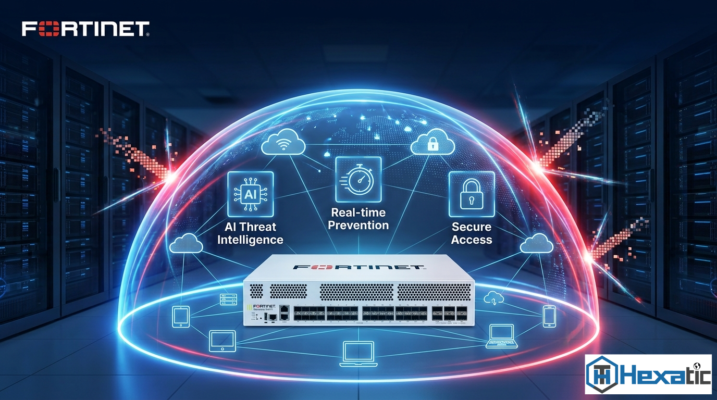
A Next-Generation Firewall (NGFW) is one of the key components of a modern cybersecurity architecture. FortiGate, developed by Fortinet, combines firewall capabilities with advanced threat prevention, application control, secure connectivity, visibility, and networking functions.
Fortinet describes FortiGate NGFWs as solutions designed to protect data, users, and assets across hybrid environments, with capabilities including AI-powered security services, Secure SD-WAN, Zero Trust Network Access (ZTNA), and centralized management.
What Is a FortiGate Firewall?
FortiGate is Fortinet’s family of Next-Generation Firewalls designed to secure networks across different environments, including enterprise campuses, branches, data centers, cloud environments, and distributed networks.
Unlike a traditional firewall that primarily filters traffic based on network addresses and ports, an NGFW can provide deeper inspection and security controls around applications, users, devices, content, and threats.
FortiGate runs on FortiOS, Fortinet’s security operating system. FortiOS provides capabilities for network security, application visibility, secure access, SD-WAN, Zero Trust, and integration with the broader Fortinet Security Fabric.
Key Features of FortiGate Firewall
1. Next-Generation Firewall Protection
FortiGate provides traditional firewall functionality together with advanced security inspection.
Organizations can create policies based on factors such as:
- IP addresses and network zones
- Applications
- Users
- Devices
- Services and protocols
- Security profiles
- Web categories
- Network behavior
This gives IT and security teams greater control over who can access what, from where, and under which conditions.
2. Intrusion Prevention System (IPS)
FortiGate includes Intrusion Prevention System capabilities to detect and block malicious or suspicious network activity.
IPS can help protect organizations against:
- Exploitation attempts
- Vulnerability attacks
- Malicious network traffic
- Command-and-control communication
- Known attack patterns
Fortinet combines FortiGate with FortiGuard security services to provide threat intelligence and security updates.
3. Antivirus and Malware Protection
Malware remains a significant threat to organizations. A compromised endpoint can potentially lead to data theft, ransomware, operational disruption, and unauthorized access.
FortiGate can inspect traffic and files for malicious content, providing another layer of protection between users and external threats.
This is particularly useful for organizations that want to reduce the likelihood of malware entering their network through internet traffic and other communication channels.
4. Application Control
Modern businesses depend on hundreds of applications and cloud services.
FortiGate provides application visibility and control, allowing organizations to identify applications running across their networks and apply policies to them.
For example, an organization may want to:
- Allow business-critical applications
- Restrict unauthorized applications
- Control high-risk services
- Limit unnecessary bandwidth consumption
- Monitor cloud application usage
Fortinet highlights application visibility as an important part of FortiGate’s ability to provide contextual network security.
5. Web and URL Filtering
Employees regularly access websites and online services as part of their daily work. However, malicious websites can become entry points for phishing, malware, credential theft, and other attacks.
FortiGate can provide web and URL filtering to help organizations:
- Block malicious websites
- Restrict inappropriate categories
- Control access to risky web services
- Support acceptable-use policies
- Reduce exposure to web-based threats
6. SSL/TLS Inspection
Much of today’s internet traffic is encrypted. While encryption protects legitimate communication, attackers can also use encrypted connections to hide malicious activity.
FortiGate supports inspection of encrypted traffic so organizations can apply security controls to applicable traffic.
Fortinet specifically highlights encrypted-traffic inspection as an important capability of its FortiGate platform.
SSL/TLS inspection should, however, be designed carefully because it can have privacy, compliance, certificate-management, and performance implications.
7. VPN and Secure Remote Connectivity
Organizations increasingly have employees working remotely and offices operating from different geographical locations.
FortiGate can support secure connectivity between:
- Headquarters and branches
- Branches and data centers
- Remote employees and corporate resources
- Corporate networks and cloud environments
This enables organizations to provide controlled remote access without unnecessarily exposing internal systems to the public internet.
8. Secure SD-WAN
Organizations with multiple branches often need reliable and secure connectivity between offices and cloud applications.
FortiGate integrates security and SD-WAN capabilities, helping organizations build secure WAN infrastructure while simplifying connectivity between locations. Fortinet positions Secure SD-WAN as a way to improve user experience, simplify operations, and potentially lower total cost of ownership.
9. Zero Trust Network Access
Traditional network security models often assume that users inside the network can be trusted. Modern security strategies increasingly follow a Zero Trust model.
FortiGate supports ZTNA capabilities that can help organizations provide controlled application access based on factors such as identity, device, and security context.
This is especially useful for organizations with:
- Remote employees
- Hybrid workforces
- Cloud applications
- Multiple offices
- Third-party users
- Distributed infrastructure
10. Centralized Visibility and Management
As organizations grow, managing multiple security devices and policies can become complicated.
Fortinet’s Security Fabric and management technologies are designed to provide broader visibility and centralized control across connected security and networking components.
This can help IT teams understand:
- What is happening on the network
- Which applications are being used
- Which users and devices are communicating
- Where threats are being detected
- Which security policies are being triggered
FortiGate Solutions by Hexatic Tech Pvt. Ltd.
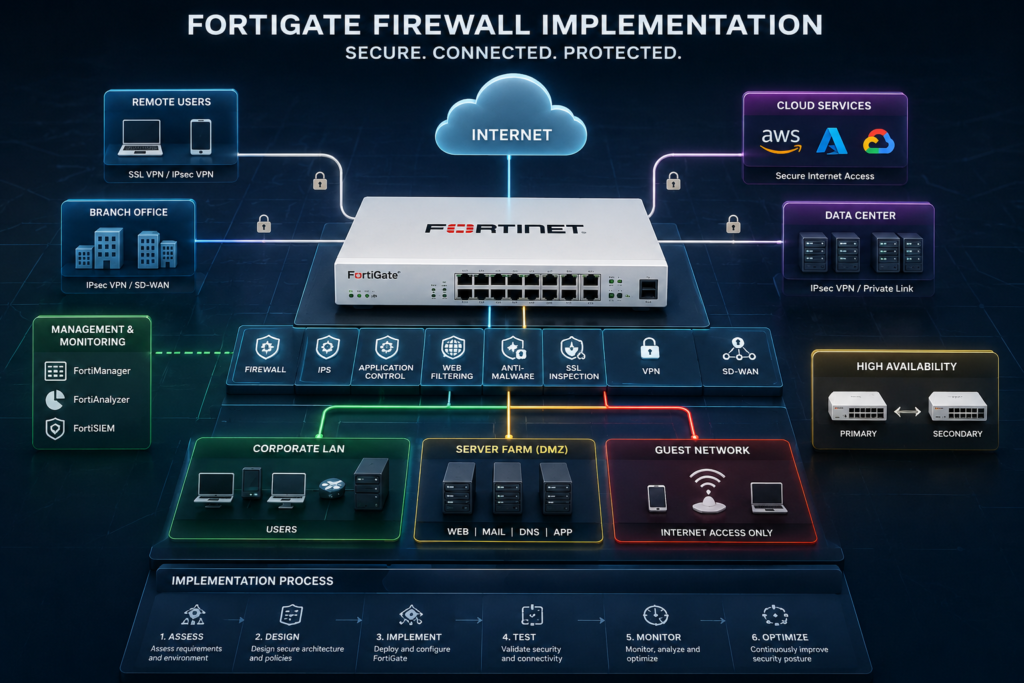
Technology selection is only the beginning of a successful firewall deployment. A FortiGate solution needs to be properly assessed, architected, implemented, secured, monitored, and maintained.
Hexatic Tech Pvt. Ltd. positions itself as a technology and cybersecurity partner focused on secure, scalable, and business-critical environments. Its cybersecurity practice covers network and cloud security, including NGFW, WAF, ZTNA, and threat intelligence, while its technology ecosystem includes Fortinet. Based on Hexatic’s published cybersecurity capabilities, its FortiGate engagement can be positioned as a comprehensive approach covering assessment, solution design, implementation, network segmentation, secure SD-WAN, remote access, security monitoring, managed services, and compliance-oriented security.
- Security and Network Assessment
Before implementing a firewall, Hexatic can assess an organization’s existing environment and security requirements, including the current network architecture, internet and branch connectivity, existing firewall infrastructure, remote-access requirements, cloud connectivity, security gaps, and compliance considerations. The objective is to identify an architecture that aligns the technology with business and security requirements rather than simply deploying a firewall appliance.
FortiGate Solution Design
Every organization has different security and networking requirements. A small business may require a straightforward internet-edge firewall, while an enterprise may need multiple firewalls, redundant connectivity, network segmentation, VPN, SD-WAN, cloud integration, and centralized management. Hexatic’s broader infrastructure and cybersecurity approach can be used to design FortiGate solutions around the organization’s operational and security requirements, integrating infrastructure, cybersecurity, governance, and long-term operational considerations.
FortiGate Implementation and Configuration
A firewall is only as effective as its configuration. A FortiGate deployment can include initial firewall configuration, interface and routing configuration, security-zone design, firewall policy creation, NAT configuration, VPN configuration, web and application-control policies, IPS and security-profile configuration, network segmentation, logging and monitoring, and high-availability configuration where required. Proper implementation helps ensure that security controls protect the organization without unnecessarily affecting business connectivity and operations.
Secure Network Segmentation
Hexatic’s cybersecurity practice addresses IT, OT, and network security, including segmentation based on the Purdue Model for OT environments. FortiGate can therefore be incorporated into broader segmentation strategies designed to separate users, servers, production environments, IoT systems, OT networks, and other critical assets. This approach can help organizations limit unnecessary communication between network segments and strengthen their overall security posture.
Secure SD-WAN and Branch Connectivity
For organizations with multiple locations, Hexatic can incorporate FortiGate into a broader secure networking architecture supporting branch-to-head-office connectivity, branch-to-cloud connectivity, multiple WAN links, traffic optimization, centralized security policies, and secure remote locations. FortiGate’s integrated SD-WAN capabilities enable organizations to combine WAN connectivity and security functionality within a unified platform while supporting centralized management and policy enforcement.
VPN and Remote Access
Organizations increasingly require secure access for employees, contractors, and distributed teams. FortiGate can be implemented as part of a remote-access strategy using appropriate VPN and/or ZTNA capabilities, depending on the organization’s requirements. This can help provide controlled access to business applications and resources while supporting security policies for remote and distributed users.
Security Monitoring and Managed Services
Deploying a firewall is not the end of cybersecurity. Threats, users, applications, vulnerabilities, and business requirements continuously evolve. Hexatic publicly offers managed security capabilities, including managed SOC and security monitoring services, incident readiness and response planning, cybersecurity strategy, and risk advisory. This creates an opportunity to position FortiGate as one component of a broader managed cybersecurity service, where the firewall can be monitored, reviewed, and optimized as part of the organization’s overall security environment rather than treated as an isolated product.
Compliance-Oriented Security
Many organizations operate under regulatory, industry, and contractual requirements. Hexatic’s cybersecurity and compliance practice includes support around frameworks and standards such as ISO/IEC 27001, SOC 2, and the NIST Cybersecurity Framework. FortiGate can contribute to an organization’s technical security controls, while Hexatic can help align those controls with broader security governance, risk management, and compliance requirements.
Conclusion
FortiGate is a modern Next-Generation Firewall platform that combines network security with advanced threat protection, application control, secure connectivity, SD-WAN, Zero Trust capabilities, visibility, and centralized management.
For organizations, its value goes beyond simply blocking unwanted traffic. A properly designed FortiGate solution can help businesses:
However, successful firewall deployment depends on much more than the product itself; Architecture, configuration, monitoring, governance, compliance, and ongoing optimization are critical to achieving the desired security outcomes.
This is where Hexatic Tech Pvt. Ltd. can add value. With capabilities spanning cybersecurity, network and cloud security, IT security, compliance, infrastructure, managed security, and Fortinet within its technology ecosystem, Hexatic can help organizations approach FortiGate as part of a broader, business-aligned cybersecurity strategy.
FortiGate provides security technology… Hexatic helps organizations turn that technology into a structured, secure, and scalable solution !