
- August 10 2026
-
 Amar Khadake
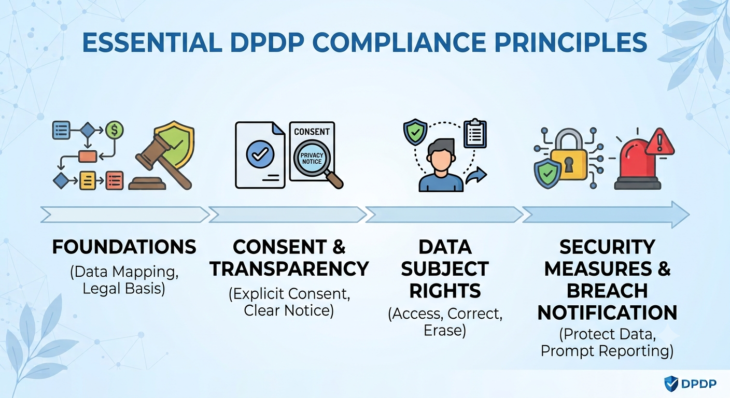
As India strengthens its data privacy framework, organizations must prepare to comply with the Digital Personal Data Protection (DPDP) Act, 2023. Whether you’re a startup, SME, or large enterprise, a structured readiness checklist can help you identify compliance gaps, strengthen data governance, and build trust with customers.
This blog outlines a practical DPDP Readiness Checklist for 2026 to help your organization prepare for compliance.
Digital Personal Data Protection Act 2023
It is India’s comprehensive data protection law,offering a legal framework for handling digital personal data, with the goal of safeguarding individual privacy while permitting lawful data processing. The act covers end to end personal data lifecycle,covering collection,consent,processing,storage,sharing,retention,and secure disposal.
The law emphasizes transparency,accountability, and security at every stage,ensuring that organizations adopt privacy by design principles.The DPDP act is overseen by the Data Protection Board Of India which acts as a regulatory authority.
What is DPDP Readiness?
DPDP readiness refers to an organization’s ability to comply with the requirements of the Digital Personal Data Protection (DPDP) Act by implementing the necessary policies, processes, technical controls, and governance mechanisms for protecting personal data.
Being DPDP-ready means your organization can:
- Process personal data lawfully and transparently.
- Protect personal data with appropriate security measures.
- Respond to data subject requests efficiently.
- Detecting and responding to data breaches.
- Demonstrate compliance during audits or regulatory reviews.
Why DPDP Readiness Matters in 2026
Organizations that invest in privacy readiness benefit from:
- Improved customer trust.
- Better information security.
- Stronger governance.
- Reduced compliance risks.
- Faster enterprise sales (especially for SaaS companies)
- Better preparation for ISO 27001 and SOC 2 audits.
- Enhanced reputation and brand value.
Key Terms
Data Fiduciary – Any person who alone or in conjunction with other persons or organisations determines the purpose and the means of processing of personal data.
Data Principal – The individual to whom the personal date relates
Data Processors – Any entity that processes personal data on behalf of Data Fiduciary
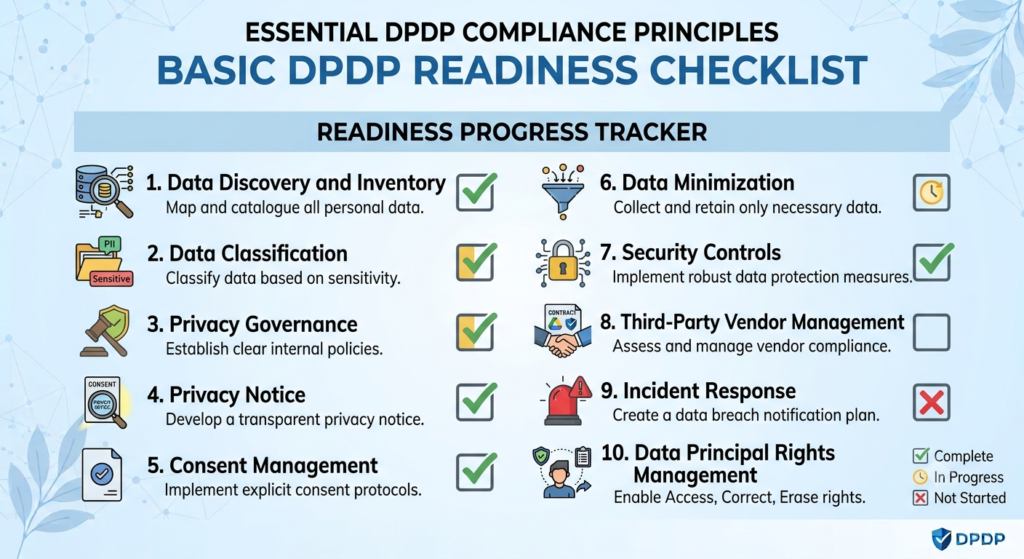
DPDP Readiness Checklist for 2026
1. Data Discovery and Inventory
The first step is understanding what personal data your organization collects and processes.
- Identify all personal data collected.
- Identify data owners.
- Document data storage locations.
- Map cloud and on-premises systems.
- Identify sensitive personal data.
2. Data Classification
Classify information based on sensitivity.
Example classifications:
- General personal data : Basic identifiers like names, phone numbers, work emails, and that require standard notice and consent.
- Special / High-Risk data : High-risk information including Health records, financial details, biometric identifiers needing strict encryption and access limits.
- Children and Persons with Disabilities – Data pertaining to anyone under 18 years old and persons with disabilities (PwDs) who have lawful guardians.
3. Privacy Governance
Establish clear accountability.
- Appoint a Privacy Lead or, where applicable, a Data Protection Officer(DPO).
- Define privacy responsibilities of the data fiduciary.
- Establish privacy governance meetings.
- Review compliance regularly.
4. Privacy Notice
A Privacy notice is a mandatory disclosure given to data principals before or at the time of collecting consent.
Your Privacy Notice should clearly explain:
- What personal data is collected?
- Why is it collected?
- How is it used?
- Who is it shared with?
- Data retention periods
- Data Principal rights
- Contact details for privacy inquiries
5. Consent Management
Where consent is required, Data Fiduciaries must:
- Obtain valid, clear and purpose specific consent.
- Maintain audit logs.
- Enable simple mechanisms to withdraw consent anytime.
6. Data Minimization
Data minimization under section 6 of the DPDP Act means collecting minimum personal data necessary for your processing purposes.
Questions an organization should ask before collecting personal data:
- Is this information necessary?
- Can we achieve the objective with less data?
- Are duplicate records removed?
- Security Controls
A Data Fiduciary shall protect the personal data in its possession or under its control by taking reasonable security safeguards to prevent personal data breaches.
Examples include :
- Use Multi-Factor Authentication (MFA)
- Encryption of data both at rest and in transit.
- Endpoint protection
- Access Control using a strict role-based and need-to-know model.
- Apply firewalls
- Vulnerability management
8. Third-Party Vendor Management
Before onboarding any third-party vendor or data processor, a data fiduciary must ensure that the vendor is fully compliant with applicable legal, regulatory, and contractual obligations.
Organisations must conduct a structured risk and compliance review covering the following:
- Security certifications
- Privacy practices
- Compliance status
- Incident response capabilities
- Data Processing Agreements (DPAs)
Maintain a Vendor Risk Register and conduct regular compliance reviews and performance audits over the lifecycle of the contract.
9. Incident Response
Prepare a structured step-by-step document aligning with the DPDP act to identify threats in time and contain the damage.
Your Incident Response Plan should include:
- Detection – Establish continuous visibility
- Investigation – Understand the full extent of the breach
- Containment – Stop ongoing data exposure
- Recovery – Patch flaws and retain logs
- Notification – Notify the Data Protection Board Of India and affected Data Principals in accordance with applicable legal and regulatory requirements.
- Continuous monitoring
10. Data Principal Rights Management
Data principles rights are the rights granted to the individual to ensure they have control over the processing of their personal data.
Core rights:
- Right to Access information about personal data
- Right to correction and erasure of the personal data.
- Right to withdraw consent.
- Right to nominate another person to exercise their rights in case of death or incapacity.
- Right of grievance redressal.
Track requests and response times.
Cross-Border Data Transfer under the DPDP Act:
Cross-border data transfer is generally permitted, subject to restrictions imposed by the central government.
- Section 16 of the DPDP Act allows the transfer of data provided it complies with the DPDP Act and applicable Rules.
- Personal data of Indian citizens can be transferred to any country outside India,unless the central government issues a notification restricting that country.
Common DPDP Compliance Gaps
These are the major gaps that many organizations struggle with:
- Lack of data inventory
- Weak consent tracking
- Inconsistent data retention
- Missing vendor assessments
- Limited employee awareness
- Poor documentation
- No formal incident response process
Identifying and addressing these issues early helps reduce compliance risk.
Best Practices for DPDP Readiness
- Establish a cross-functional privacy governance team.
- Maintain an accurate inventory of personal data.
- Adopt privacy-by-design in new products and services.
- Review vendors regularly.
- Test incident response plans through simulations.
- Train employees on privacy and security awareness.
- Conduct periodic risk assessments.
- Keep policies and procedures up to date.
To make this whole process simple and less tedious, Hexatic has developed an AI-powered Governance, Risk, and Compliance (GRC) platform ComplyPhi where your organization can operationalize DPDP compliance with ease.
How ComplyPhi Can Help
A Governance, Risk, and Compliance (GRC) platform like ComplyPhi can simplify DPDP readiness by providing:
- Policy Management: Centralized creation, review, approval, and version control of compliance policies.
- Risk Management: Risk registers, assessments, treatment plans, and dashboards.
- Asset & Data Inventory: Maintain records of systems, assets, and data processing activities.
- Vendor Risk Management: Track third-party assessments, contracts, and review cycles.
- Task & Workflow Automation: Assign responsibilities, monitor progress, and receive reminders.
- Evidence Management: Store audit evidence, reports, and compliance artifacts in one place.
- Audit Readiness: Generate reports and maintain documentation for internal and external audits.
- Compliance Dashboards: Monitor readiness across DPDP, ISO 27001, SOC 2, and other frameworks.
Conclusion
DPDP readiness is not a one-time activity—it is a continuous process of improving governance, security, and privacy practices. Organizations that implement strong controls, maintain accurate documentation, and regularly assess their compliance posture will be better equipped to meet regulatory expectations and protect the personal data entrusted to them.
By following this checklist and leveraging compliance management tools such as ComplyPhi, businesses can streamline their privacy programs, reduce manual effort, and stay prepared for audits and future regulatory changes.