

October 2026 Cyberattacks: Key Lessons for Businesses
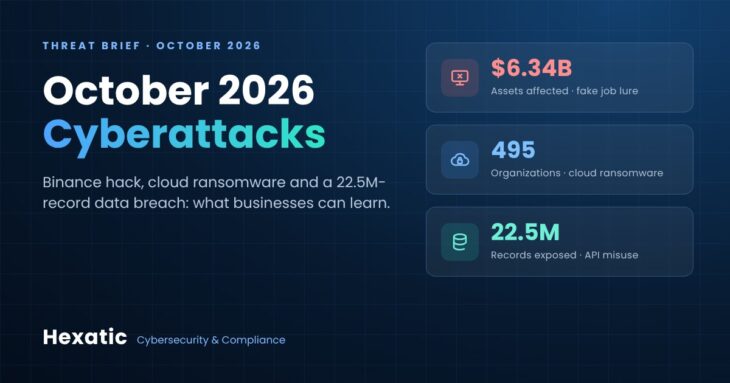
TL;DR: In October 2026, three incidents showed how attackers abuse trusted access. Binance reported about $6.34 billion in digital assets affected after a fake job interview led to a compromised engineer device. A ransomware attack on IDCF Cloud affected 495 organizations. Sourcenext said 22,519,960 customer records may have been exposed through an API. The lessons: tighten identity and access controls, secure endpoints, assess cloud and API security, manage vulnerabilities continuously, and rehearse incident response.
How the Binance $6.34 billion hack, IDCF Cloud ransomware attack, and Sourcenext data breach exposed critical cybersecurity risks, and what businesses can learn.
October 2026 was a significant month for cybersecurity. Three major incidents demonstrated how attackers can exploit employee devices, cloud infrastructure, and application security weaknesses to disrupt businesses and compromise valuable information.
The incidents included:
- Binance: Approximately $6.34 billion in digital assets affected by a sophisticated cyberattack.
- IDCF Cloud: A ransomware attack affecting cloud infrastructure used by 495 organizations.
- Sourcenext: Unauthorized access potentially exposing more than 22.5 million customer records.
Although these attacks targeted different industries, they revealed a common challenge: organizations must protect not only their data but also the people, applications, and infrastructure that can access it.
In this article, we explain what happened during these October 2026 cyberattacks, how they worked, and the lessons businesses can apply to strengthen their cybersecurity.
1. Binance Hack: How a Fake Job Interview Became a $6.34 Billion Cyberattack
On October 29, 2026, Binance experienced a major cybersecurity incident involving unauthorized cryptocurrency transactions.
According to its November 3 investigation update, approximately $6.34 billion in digital assets were affected.
How Did the Binance Hack Happen?
The attack involved a sophisticated combination of social engineering, malicious software, compromised employee devices, and unauthorized access to internal infrastructure.
Binance’s preliminary investigation identified several stages:
- Attackers approached employees through fake recruitment opportunities.
- A software engineer was persuaded to download a malicious coding assignment.
- The malware compromised the employee’s device.
- Attackers subsequently exploited compromised internal AI tooling and obtained deployment credentials.
- These credentials helped attackers access critical wallet infrastructure and initiate unauthorized cryptocurrency transactions.
Understanding the Attack in Simple Terms
Imagine receiving a job interview invitation from someone who appears to represent a legitimate company.
During the interview, you are asked to download a coding assignment.
However, the downloaded files contain hidden malicious software.
Once installed, the malware may allow attackers to access your computer and potentially reach other systems connected to your workplace.
This illustrates how attackers can exploit human trust to bypass technical security defenses.
What Was the Impact?
Binance reported approximately $6.34 billion in affected digital assets.
By November 3, the company stated that approximately $2.85 billion had been frozen or intercepted.
Binance also committed to covering customer losses using company resources. As of October 31, it reported that 98% of the affected token assets had been replenished.
These findings were preliminary, with further independent review planned.
What Can Businesses Learn?
The Binance incident highlights the importance of:
- Endpoint detection and response.
- Employee cybersecurity awareness.
- Identity and Access Management (IAM).
- Privileged access monitoring.
- Secure software development environments.
- Strong controls around internal AI tools.
Key takeaway: A compromised employee device can become an entry point to critical business infrastructure when security boundaries are insufficient.
2. IDCF Cloud Ransomware Attack: 495 Organizations Affected
On October 7, 2026, Japanese cloud service provider IDC Frontier experienced a ransomware attack affecting part of its IDCF Cloud infrastructure.
According to its official October 27 investigation report, the incident affected services used by 495 companies and local government organizations.
How Did the Attack Happen?
Attackers exploited a vulnerability in open-source software used by the authentication system of the IDCF Cloud management portal.
After gaining unauthorized access, they obtained administrative privileges within the virtualization infrastructure.
The attackers then stopped and encrypted some customer virtual servers, disrupting access to essential services.
Understanding the Attack in Simple Terms
Imagine several businesses operating from a shared office building.
If someone compromises the building’s central access system, multiple businesses could experience disruption.
Cloud infrastructure faces a similar risk because many customers depend on shared management systems.
A security weakness in those systems can affect multiple organizations.
What Was the Impact?
The attack affected 495 customer organizations in specific cloud zones.
Some customers experienced server shutdowns and difficulties restoring services.
IDC Frontier reported that its investigation found no evidence of customer virtual-server data being transferred outside the affected environment.
However, the company identified unauthorized queries involving registration information associated with up to 71 customer organizations.
What Can Businesses Learn?
The incident demonstrates why cloud security must include:
- Regular vulnerability assessments.
- Strong administrative access controls.
- Independent backups.
- Disaster recovery planning.
- Infrastructure monitoring.
- Secure cloud configurations.
Key takeaway: Cloud adoption improves flexibility and scalability, but organizations must still prepare for security incidents and service disruptions.
3. Sourcenext Data Breach: 22.5 Million Customer Records Potentially Exposed
Japanese software company Sourcenext disclosed a significant security incident on October 15, 2026.
The company confirmed unauthorized access to customer information through an application programming interface, commonly known as an API.
Its investigation identified 22,519,960 customer records that may have been exposed.
How Did the Sourcenext Breach Happen?
According to the company’s disclosure, attackers began accessing customer information on October 9 by misusing an API designed to retrieve membership information.
An API allows different applications and systems to exchange information.
For example, when you log into an application and view your account details, an API may retrieve that information from a database.
If an API does not properly restrict access, unauthorized users may be able to retrieve sensitive information.
What Customer Information Was at Risk?
Potentially affected information included:
- Names and email addresses.
- Passwords.
- Phone numbers and addresses.
- Dates of birth.
- Company and employment-related information.
- Account registration details.
Not every record contained all these fields.
Sourcenext also confirmed that credit card information was not stored in the affected system.
Why Does This Matter?
Stolen customer information can be used for phishing, impersonation, and attempts to access other accounts.
For example, attackers may send fraudulent emails pretending to represent a trusted organization.
They may also attempt to use exposed passwords on other platforms.
This is why data breaches can create risks beyond the organization originally affected.
What Can Businesses Learn?
Organizations should prioritize:
- API security testing.
- Strong authentication and authorization.
- Database access controls.
- Sensitive data protection.
- Security monitoring.
- Regular vulnerability assessments.
Key takeaway: Protecting customer information requires securing the applications, APIs, and databases operating behind a website.
4. What Do These October 2026 Cyberattacks Have in Common?
Although the incidents involved different industries, they highlighted a common cybersecurity challenge: attackers can exploit weaknesses in trusted systems to reach sensitive resources.
The Binance incident demonstrated the risks of compromised employee devices and privileged access.
The IDCF Cloud attack showed how vulnerabilities in shared infrastructure can disrupt multiple organizations.
The Sourcenext breach highlighted the importance of securing APIs and customer information systems.
Together, these incidents reinforce three essential cybersecurity principles.
Never Assume Trusted Access Is Automatically Safe
Employees, applications, and internal systems should receive only the permissions necessary to perform their responsibilities.
This principle is commonly known as least-privilege access.
Security Must Cover the Entire IT Environment
Protecting a firewall or installing antivirus software is not enough.
Organizations must also secure employee devices, cloud infrastructure, applications, APIs, and privileged accounts.
Cybersecurity Must Include Business Continuity
Even strong security controls cannot guarantee that an organization will never experience an incident.
Businesses need effective monitoring, incident response plans, reliable backups, and tested recovery procedures.
5. Five Cybersecurity Measures Every Business Should Prioritize
The October 2026 incidents offer practical lessons for organizations of all sizes.
1. Strengthen Identity and Access Management
Implement multifactor authentication, role-based access controls, and regular access reviews.
Privileged permissions should be restricted and continuously monitored.
2. Improve Endpoint Security
Protect employee laptops, servers, and other devices through endpoint security solutions, timely updates, and suspicious activity monitoring.
Employees should also receive cybersecurity awareness training.
3. Secure Cloud Infrastructure and Applications
Regularly assess cloud configurations, applications, APIs, and authentication systems for vulnerabilities.
4. Implement Continuous Vulnerability Management
Conduct vulnerability assessments and prioritize remediation based on the severity and potential business impact of identified weaknesses.
5. Prepare for Security Incidents
Maintain secure backups, establish incident response procedures, and regularly test disaster recovery plans.
These measures help organizations reduce security risks and improve their ability to respond when incidents occur.
6. How Hexatic Helps Businesses Strengthen Cybersecurity
The October 2026 cyberattacks demonstrate why businesses need a proactive approach to cybersecurity.
At Hexatic Tech Pvt. Ltd., we help organizations strengthen their IT infrastructure, improve security controls, and build more resilient technology environments through our cybersecurity and compliance services.
Our focus includes several important areas.
Cloud Security and Infrastructure Management
We help organizations improve cloud configurations, infrastructure security, access controls, and operational monitoring.
Identity and Access Management
We support secure user access, role-based permissions, multifactor authentication, and privileged access management.
Endpoint Security and IT Management
We help businesses strengthen endpoint protection, device management, and IT security monitoring.
Vulnerability Management and Security Assessments
We support vulnerability identification, security assessments, and remediation planning to help organizations address potential security weaknesses.
Security Compliance and Governance
We help organizations strengthen information security practices and align with frameworks such as ISO 27001 and SOC 2.
By combining technical security controls with governance and risk management, Hexatic helps businesses build stronger cybersecurity foundations.
Is Your Business Prepared for the Next Cyberattack?
Not sure where you stand? Take our free Security & Compliance Posture Check: 16 questions, about 4 minutes, with instant results and a prioritized list of gaps.
Cybersecurity threats continue to evolve, and businesses need security strategies that evolve with them.
Whether your organization needs stronger cloud security, improved identity management, endpoint protection, or compliance support, Hexatic can help identify opportunities to strengthen your security posture.
Connect with Hexatic Tech Pvt. Ltd. to discuss your organization’s cybersecurity and infrastructure security requirements.
7. Frequently Asked Questions About October 2026 Cyberattacks
What happened in the Binance hack in October 2026?
On October 29, 2026, Binance experienced a cyberattack involving unauthorized cryptocurrency transactions. Approximately $6.34 billion in digital assets were affected. The company’s preliminary investigation identified compromised employee devices, malicious software, stolen credentials, and unauthorized access to wallet infrastructure.
What were the major cybersecurity incidents in October 2026?
Notable incidents included the Binance cryptocurrency hack, the IDCF Cloud ransomware attack affecting 495 organizations, and the Sourcenext incident involving more than 22.5 million potentially exposed customer records.
How can businesses protect themselves from cyberattacks?
Businesses can strengthen cybersecurity through multifactor authentication, endpoint protection, cloud security assessments, vulnerability management, employee training, and incident response planning.
Can cloud infrastructure be affected by ransomware?
Yes. Cloud infrastructure can be affected when attackers exploit vulnerabilities or gain unauthorized access to administrative systems. Organizations should maintain secure configurations, reliable backups, and disaster recovery procedures.
Why is Identity and Access Management important?
Identity and Access Management helps organizations control access to applications, systems, and sensitive information. Strong IAM practices reduce the risks associated with compromised accounts and excessive permissions.
8. Conclusion: Building Cybersecurity Resilience Beyond October 2026
The major cyberattacks of October 2026 demonstrate that cybersecurity risks extend beyond individual systems or technologies.
The Binance incident highlighted the dangers of compromised employee devices and privileged infrastructure access.
The IDCF Cloud ransomware attack demonstrated how vulnerabilities in shared infrastructure can disrupt hundreds of organizations.
The Sourcenext breach reinforced the importance of protecting APIs and sensitive customer information.
Together, these incidents reveal an important lesson: effective cybersecurity requires protecting the entire digital environment, not just individual applications or devices.
Organizations must continuously assess risks, strengthen access controls, secure infrastructure, monitor suspicious activity, and prepare for potential security incidents.
At Hexatic Tech Pvt. Ltd., we believe cybersecurity is fundamental to business continuity, customer trust, and long-term digital resilience.
Because strong cybersecurity is not just about preventing attacks. It is about ensuring your business is prepared to respond, recover, and continue operating when threats emerge.
Secure your infrastructure. Protect your data. Strengthen your business with Hexatic.
Related Reading
- SBI Cyberattack: Reported Customer Data Exposure Highlights the Need for Stronger Cybersecurity
- Zero Trust for AI Agents: Why Every Agent Needs Its Own Identity, Permissions and Audit Trail
- ISO 27001:2022: Understanding the 11 New Annex A Controls
References
The incident details in this article are based on official company disclosures available as of November 4, 2026.
- Binance (November 3, 2026): 29 October 2026 Binance Security Incident: Initial Findings and Response Update
- IDC Frontier (October 27, 2026): Investigation Results and Response to Unauthorized Access
- Sourcenext (October 15, 2026): Notice Regarding Unauthorized Access and Customer Information Exposure
The incident figures and descriptions above were checked against the three official reports listed here.