
- October 13 2026
-
 Akshay Joshi
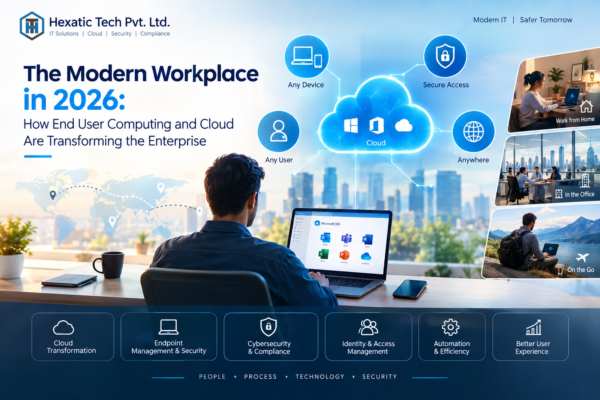
The Modern Workplace in 2026 : How End User Computing and Cloud are Transforming the Enterprise
The way employees work has changed dramatically over the last few years. Users are no longer limited to traditional office desktops, corporate networks, or a single workplace location. Today, employees expect secure and seamless access to applications, data, and collaboration tools whether they are working from an office, home, or anywhere in the world.
This transformation has made End User Computing (EUC) and Cloud Computing two critical pillars of the modern enterprise IT environment.
For organizations, the challenge is no longer simply providing devices and applications. The real challenge is creating a secure, scalable, manageable, and productive digital workplace.
At Hexatic Tech Pvt. Ltd., we see this transformation as an opportunity to help organizations build modern IT environments that combine user experience, cloud capabilities, security, and operational efficiency.
What Is End User Computing?
End User Computing refers to the technologies, platforms, processes, and services that enable employees to securely access the resources they need to perform their jobs.
Modern EUC goes beyond traditional desktop management. It includes:
- Endpoint and device management
- Identity and access management
- Virtual desktops and application delivery
- Microsoft 365 and cloud applications
- Endpoint security
- User experience monitoring
- Remote and hybrid workplace enablement
- Automation and policy-based management
The objective is simple:
Give users the right access, on the right device, at the right time—without compromising security.
Why EUC and Cloud Are Becoming One Strategy
Traditionally, endpoint management and cloud infrastructure were treated as separate IT functions.
Today, that approach is changing.
Cloud platforms provide organizations with flexibility and scalability, while modern EUC technologies allow IT teams to manage users, devices, applications, identities, and policies centrally.
For example, an organization can combine:
Cloud Infrastructure + Identity + Endpoint Management + Security + Collaboration
to create a unified digital workplace.
This approach reduces dependency on traditional infrastructure and allows IT teams to respond faster to changing business requirements.
The Rise of Cloud-Managed Endpoints
One of the biggest changes in EUC is the movement from traditional on-premises device management toward cloud-based endpoint management.
Organizations increasingly want centralized visibility and control over:
- Windows devices
- macOS devices
- Mobile devices
- Applications
- Security policies
- Compliance configurations
- User identities
- Device health
Cloud-based management enables IT teams to deploy policies and applications remotely while maintaining better visibility across the organization’s endpoint environment.
This becomes particularly important for organizations supporting hybrid and remote employees.
Security Must Be Built Into the Workplace
A modern workplace cannot be considered successful if it focuses only on user convenience.
Every endpoint represents a potential entry point into the organization’s environment.
Therefore, EUC strategy must be closely connected with cybersecurity.
Organizations should consider:
Identity Security → Device Security → Application Security → Data Security → Continuous Monitoring
Some important security controls include:
- Multi-factor authentication
- Conditional access
- Endpoint Detection and Response
- Device compliance policies
- Privileged access controls
- Application control
- Data Loss Prevention
- Security monitoring
- Regular patching and vulnerability management
The goal is not simply to protect the network.
The modern security perimeter is the user, identity, device, application, and data.
AI Is Changing End User Computing
Artificial Intelligence is becoming another important component of the modern workplace.
AI can help IT teams move from reactive support to proactive IT operations.
Potential use cases include:
- Predicting endpoint failures
- Identifying abnormal user activity
- Automating IT support
- Generating troubleshooting recommendations
- Automating repetitive administrative tasks
- Improving application performance monitoring
- Supporting IT service desks
- Analysing user experience data
AI-powered capabilities can help IT teams spend less time on repetitive operational tasks and more time on strategic initiatives.
However, organizations must also consider AI governance, data privacy, access control, and security before adopting AI at scale.
Automation: The Key to Scalable EUC Operations
As organizations grow, manually managing users and endpoints becomes increasingly difficult.
Automation can significantly improve operational efficiency.
For example, PowerShell and other automation technologies can help IT teams automate:
- User provisioning
- Application deployment
- Device configuration
- Group membership
- Reporting
- Compliance checks
- Troubleshooting activities
- Routine administrative tasks
A well-designed automation strategy can reduce human error, improve consistency, and allow IT teams to support a larger environment without proportionally increasing operational effort.
The Importance of User Experience
Security and control are important, but the employee experience cannot be ignored.
A highly secure environment that makes employees struggle to access applications can negatively impact productivity.
Modern EUC therefore needs to balance three key objectives:
Security
Protect users, devices, applications, and organizational data.
Productivity
Ensure employees can access the tools they need quickly and reliably.
Experience
Provide a seamless and consistent digital workplace.
The best EUC strategy is one where security operates in the background while users experience a simple and productive workplace.
Building a Modern EUC & Cloud Strategy
Organizations planning their modernization journey should consider a structured approach.
1. Assess
Understand the existing environment:
- Devices
- Applications
- Users
- Identity infrastructure
- Cloud adoption
- Security posture
- Existing management tools
2. Design
Create the target architecture covering:
- Endpoint management
- Identity
- Cloud
- Security
- Applications
- Network
- User experience
3. Modernize
Move appropriate workloads and management capabilities toward cloud-based platforms.
4. Secure
Implement security controls based on identity, device, application, and data protection requirements.
5. Automate
Identify repetitive IT processes and automate them wherever practical.
6. Monitor & Optimize
Continuously monitor endpoint health, security posture, application performance, and user experience.
Modernization is not a one-time project. It is an ongoing journey.
Where Hexatic Tech Can Help
At Hexatic Tech Pvt. Ltd., we help organizations evaluate and modernize their IT environments across End User Computing, Cloud, IT Infrastructure, Cybersecurity, and Compliance.
Our approach focuses on understanding the organization’s business requirements first and then designing an appropriate technology and operational strategy.
Our areas of expertise include:
- End User Computing
- Endpoint Management & Security
- Microsoft 365 & Cloud Solutions
- Identity & Access Management
- IT Infrastructure
- Cybersecurity
- Cloud Transformation
- IT Automation
- Security & Compliance
- Managed IT Services
By bringing these capabilities together, organizations can build an IT environment that is not only technically capable but also secure, scalable, manageable, and aligned with business objectives.
Conclusion
The modern workplace is no longer defined by a physical office or a traditional corporate network.
It is defined by how effectively employees can securely access the applications, devices, data, and services they need—regardless of where they work.
This is why End User Computing and Cloud Computing are becoming increasingly interconnected.
Organizations that successfully combine cloud, endpoint management, identity, security, automation, and user experience will be better positioned to support the workforce of the future.
The question is no longer:
“How do we manage our users and devices?”
The better question is:
“How do we create a secure, intelligent, and frictionless digital workplace that enables our business to grow?”
At Hexatic Tech Pvt. Ltd., we believe the answer lies in bringing People + Process + Technology + Security together.
Build Modern. Work Secure. Scale Smarter.